
Understanding wealth management fees is crucial for anyone seeking professional financial guidance. These fees, which vary significantly depending on several factors, can significantly impact your overall investment returns. This guide will demystify the complexities of wealth management fees, providing a clear understanding of different structures, influencing factors, and strategies for effective negotiation.
From the various fee structures employed by wealth management firms to the legal and regulatory requirements surrounding transparency, we will explore every facet of this important topic. We’ll also delve into the relationship between the range of services offered and their associated costs, empowering you to make informed decisions about your financial future.
Defining Wealth Management Fees
Wealth management fees are the charges levied by financial advisors or firms for providing a range of services aimed at helping clients grow and manage their wealth. These fees can vary significantly depending on the services offered, the client’s assets, and the firm’s fee structure. Understanding these fees is crucial for making informed decisions about your financial planning.
Types of Wealth Management Fees
Wealth management firms typically charge fees based on several different models, each with its own advantages and disadvantages. These models aren’t mutually exclusive; many firms utilize a combination of fee structures.
Fee Structures Used by Wealth Management Firms
Several common fee structures are employed by wealth management firms. The most prevalent are percentage-based fees (often tied to assets under management), hourly fees, and performance-based fees. Some firms may also incorporate retainer fees or commission-based fees, although these are less common in comprehensive wealth management.
Fee Calculation and Disclosure
The calculation of wealth management fees is usually straightforward, though the specific details depend on the chosen fee structure. For example, a firm charging a 1% annual fee on assets under management (AUM) would calculate the fee by multiplying the client’s total investable assets by 0.01. Hourly fees are calculated based on the time spent providing services, while performance-based fees are typically a percentage of the investment gains exceeding a pre-determined benchmark.
Transparency in fee disclosure is vital. Clients should receive clear, written statements outlining all fees, how they are calculated, and the services included.
Comparison of Common Fee Structures
| Fee Structure | Description | Advantages | Disadvantages |
|---|---|---|---|
| Percentage of Assets Under Management (AUM) | A percentage of the total value of a client’s investments managed by the firm. | Simple to understand and calculate; aligns advisor’s interests with client’s growth. | Can be costly for clients with large portfolios; may not incentivize exceptional performance. |
| Hourly Rates | Charges based on the time spent on specific services. | Transparency; clients only pay for services rendered. | Can be difficult to predict total costs; may not be suitable for ongoing, comprehensive planning. |
| Performance-Based Fees | A percentage of investment profits exceeding a benchmark. | Strong incentive for the advisor to achieve high returns; aligns advisor and client interests on performance. | Potential for high fees in exceptionally successful years; may not be appropriate for all investment strategies. |
| Retainer Fees | A fixed monthly or annual fee for ongoing advisory services. | Predictable budgeting for clients; provides consistent access to advice. | May not reflect the actual amount of service provided; can be less cost-effective for clients with smaller portfolios. |
Factors Influencing Wealth Management Fees
Wealth management fees are not a one-size-fits-all proposition. Several key factors interact to determine the ultimate cost a client incurs. Understanding these factors allows for a more informed assessment of the value proposition offered by different wealth management firms and advisors. This section will explore the primary drivers of fee variation.
Asset Size and Fee Levels
The amount of assets under management (AUM) significantly influences the fee structure. Generally, wealth management firms employ tiered fee schedules, offering lower percentage-based fees for larger AUM. This is due to economies of scale; managing a larger portfolio requires proportionally less administrative effort per dollar managed. For instance, a firm might charge 1.5% for portfolios under $500,000, 1% for portfolios between $500,000 and $1 million, and 0.75% for portfolios exceeding $1 million.
These percentages are illustrative and vary widely across firms and service offerings.
Complexity of Financial Planning
The intricacy of a client’s financial situation directly impacts the fees. Clients with simple portfolios requiring basic investment management will generally incur lower fees than those with complex needs, such as estate planning, tax optimization strategies, philanthropic advising, or international investment exposure. A comprehensive financial plan necessitates more time, expertise, and resources from the advisor, leading to higher fees.
For example, a high-net-worth individual with multiple business interests, significant real estate holdings, and complex tax implications will likely pay considerably more than someone with a straightforward retirement savings plan.
Other Factors Affecting Wealth Management Fees
Several additional factors contribute to the variability in wealth management fees. The range of services offered is a key determinant. Firms offering comprehensive services, including financial planning, investment management, tax planning, and estate planning, naturally command higher fees than those focusing solely on investment management. Advisor experience and expertise also play a role; seasoned advisors with proven track records typically charge higher fees reflecting their specialized knowledge and experience.
Finally, the size and reputation of the wealth management firm itself can influence fees. Larger, established firms with extensive resources and a strong brand reputation often charge higher fees.
Relationship Between Asset Size and Fee Percentages
Transparency and Disclosure of Fees
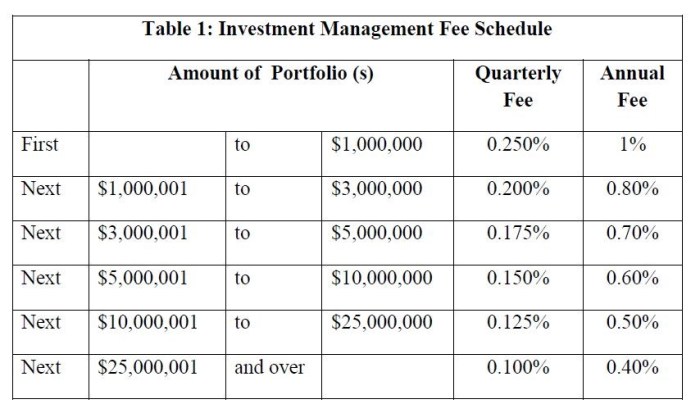
Open and honest communication about fees is paramount in building trust and fostering strong client relationships within wealth management. Transparency ensures clients understand the costs associated with the services they receive, allowing them to make informed decisions and compare offerings from different firms. This section will explore best practices, legal requirements, and common approaches to fee disclosure in the wealth management industry.
Effective fee disclosure is crucial for ethical and legal compliance. It protects both the client and the wealth management firm by preventing misunderstandings and potential disputes. A clear understanding of fees promotes client confidence and facilitates a productive advisor-client relationship built on mutual trust and transparency.
Best Practices for Clear and Concise Fee Disclosure
Clear and concise fee disclosure involves presenting all relevant fee information in a straightforward and easily understandable manner. This includes using plain language, avoiding jargon, and providing detailed explanations of any complex fee structures. For example, a firm might use a visual representation, such as a pie chart, to illustrate the breakdown of fees associated with a specific investment strategy.
Providing clients with a comprehensive fee schedule in advance, rather than presenting fees as a surprise, fosters trust and prevents any confusion. Regular review and explanation of fees, especially as investment strategies or market conditions change, is also crucial. This proactive approach demonstrates a commitment to transparency and strengthens client relationships.
Legal and Regulatory Requirements Concerning Fee Transparency
Various legal and regulatory bodies govern fee transparency in wealth management, depending on the jurisdiction. In the United States, for instance, the Securities and Exchange Commission (SEC) and the Financial Industry Regulatory Authority (FINRA) impose strict rules regarding the disclosure of fees to clients. These regulations often mandate the provision of comprehensive fee schedules, clear explanations of fee calculations, and accurate representations of all potential costs.
Failure to comply with these regulations can result in significant penalties, including fines and legal action. Similar regulatory frameworks exist in other countries, often aiming to protect investors from misleading or deceptive fee practices. Staying updated on these regulations is essential for compliance and maintaining a strong reputation.
Comparison of Fee Disclosure Methods Used by Different Wealth Management Firms
Wealth management firms employ various methods for disclosing fees. Some firms provide detailed fee schedules outlining all charges, while others use a combination of written disclosures and verbal explanations. Some firms opt for a simpler, tiered fee structure, while others may employ more complex, performance-based fee models. A comparison might show that firms specializing in high-net-worth individuals often provide more detailed, customized fee disclosures, while firms focusing on mass-market clients may adopt a more standardized approach.
The method employed often reflects the firm’s target market, service offerings, and overall business strategy. For example, a robo-advisor might present fees in a simple, transparent online dashboard, whereas a traditional wealth management firm might use a more comprehensive, printed document.
Key Elements of a Fee Disclosure Statement
A comprehensive fee disclosure statement should include several key elements to ensure transparency.
The importance of a detailed and easily understood fee disclosure statement cannot be overstated. A well-structured statement helps clients make informed decisions, promotes trust, and minimizes potential disputes. The elements listed below serve as a framework for creating a complete and legally compliant disclosure.
- All fees charged: A complete list of all fees, including advisory fees, transaction fees, custodial fees, and any other applicable charges.
- Fee calculation methods: A clear explanation of how fees are calculated, including any applicable formulas or methodologies.
- Frequency of fees: Information on how often fees are charged (e.g., annually, quarterly, or per transaction).
- Potential additional fees: Disclosure of any potential additional fees that may apply under specific circumstances.
- Fee schedule updates: A statement indicating how and when the fee schedule may be updated.
- Contact information: Contact information for inquiries or clarifications regarding fees.
- Regulatory compliance statement: A statement confirming compliance with all applicable laws and regulations.
Wealth Management
Effective wealth management goes beyond simply accumulating assets; it encompasses a strategic approach to preserving, growing, and transferring wealth across generations. This involves careful consideration of various financial instruments, risk tolerance, and long-term goals. A well-structured plan adapts to changing circumstances, ensuring the client’s financial well-being remains secure.
Key Characteristics of Effective Wealth Management Strategies
Effective wealth management strategies are characterized by a personalized approach, tailored to the unique circumstances and objectives of each individual or family. They prioritize long-term vision over short-term gains, emphasizing consistent growth and the preservation of capital. A proactive approach to risk management is crucial, alongside a commitment to transparency and open communication between the wealth manager and the client.
Regular reviews and adjustments are integral to ensuring the strategy remains aligned with evolving needs and market conditions. Furthermore, tax optimization strategies are incorporated to minimize the tax burden on accumulated wealth.
The Importance of a Holistic Approach to Wealth Management
A holistic approach to wealth management recognizes the interconnectedness of various aspects of an individual’s financial life. It integrates investment management with financial planning, estate planning, tax planning, and risk management. This integrated strategy ensures that all financial decisions are aligned towards a common goal, maximizing overall financial well-being. For example, a holistic approach might consider the impact of investment choices on estate tax liabilities or the implications of retirement planning on investment timelines.
Ignoring these interdependencies can lead to suboptimal outcomes and missed opportunities.
Risk Management in Wealth Preservation and Growth
Risk management is paramount in wealth preservation and growth. It involves identifying, assessing, and mitigating potential threats to an individual’s financial security. This includes market volatility, inflation, unexpected expenses, and legal or regulatory changes. Diversification of investments, appropriate insurance coverage, and prudent debt management are key components of a robust risk management strategy. For instance, a diversified portfolio might include a mix of stocks, bonds, real estate, and alternative investments to reduce the impact of any single asset class underperforming.
Regular portfolio rebalancing helps maintain the desired asset allocation and manage risk effectively.
Relevant Professional Designations in Wealth Management
Several professional designations signal expertise and adherence to ethical standards within the wealth management industry. These designations typically involve rigorous education, examination, and ongoing professional development requirements. Examples include the Chartered Financial Analyst (CFA), Certified Financial Planner (CFP), and Certified Public Accountant (CPA) designations. Each designation offers a specific area of expertise, contributing to a well-rounded team approach to wealth management.
Clients should consider the specific expertise offered by each designation when selecting a wealth management professional.
Navigating the world of wealth management fees requires careful consideration of several factors. By understanding the different fee structures, influencing variables, and strategies for negotiation, you can ensure you are receiving value for your investment. Remember that transparency and clear communication with your advisor are paramount to achieving your financial goals. Ultimately, the goal is to find a firm and fee structure that aligns with your financial objectives and risk tolerance.
Answers to Common Questions
What is the average wealth management fee?
The average fee varies greatly depending on factors like asset size, services offered, and the advisor’s experience. It can range from 0.5% to 2% of assets under management (AUM) annually.
Are wealth management fees tax deductible?
The deductibility of wealth management fees depends on your specific circumstances and the nature of the services rendered. Consult a tax professional for personalized advice.
Can I negotiate wealth management fees?
Yes, it’s often possible to negotiate fees, especially with larger asset sizes or when comparing multiple firms. Be prepared to discuss your needs and the value you expect in return.
What should I look for in a fee disclosure statement?
A comprehensive fee disclosure statement should clearly Artikel all fees, including any hidden or additional charges, and explain how fees are calculated.


