
Navigating the complexities of wealth management requires a deep understanding of various investment strategies. This exploration delves into the core principles of wealth management, examining diverse approaches, risk profiles, and asset allocation models. We’ll unpack active versus passive investing, explore specific investment vehicles, and address crucial aspects like risk management and tax implications. The ultimate goal is to empower individuals to make informed decisions aligned with their financial goals and risk tolerance.
From understanding the fundamental differences between holistic and segmented wealth management approaches to mastering the nuances of asset allocation, this guide provides a comprehensive framework for building a robust and sustainable investment portfolio. We’ll analyze the historical performance of various strategies, discuss ethical and sustainable investing options, and highlight the critical link between wealth management and comprehensive financial planning.
Defining Wealth Management
Wealth management encompasses a comprehensive approach to preserving, growing, and strategically utilizing an individual’s or family’s financial assets. It goes beyond simple investment advice, incorporating a holistic view of an individual’s financial life, including tax planning, estate planning, and charitable giving. The ultimate goal is to help clients achieve their long-term financial objectives, aligning investments with their overall life goals and risk tolerance.Wealth management operates on several core principles.
Firstly, it emphasizes a long-term perspective, prioritizing sustainable growth over short-term gains. Secondly, it recognizes the importance of diversification to mitigate risk. Thirdly, it stresses the need for personalized strategies, tailored to each client’s unique circumstances and aspirations. Finally, it promotes transparency and open communication between the advisor and the client, fostering a strong and trusting relationship.
Wealth Management Services
Wealth management firms offer a wide array of services designed to meet the diverse needs of their clients. These services are typically customized to the client’s net worth, investment goals, and risk tolerance.A typical suite of services might include:
- Financial Planning: Developing comprehensive financial plans that address retirement, education, and other long-term goals.
- Investment Management: Selecting and managing a portfolio of investments to achieve specific financial objectives.
- Tax Planning: Implementing strategies to minimize tax liabilities through legal and ethical means.
- Estate Planning: Creating and managing legal documents, such as wills and trusts, to ensure the efficient transfer of assets.
- Retirement Planning: Developing strategies to ensure a comfortable retirement, including managing retirement accounts and pensions.
- Insurance Planning: Assessing and managing insurance needs to protect against various risks.
- Charitable Giving: Assisting clients in making charitable donations in a tax-efficient manner.
Wealth Management Approaches
Different wealth management firms employ various approaches, each with its own strengths and weaknesses. Two common approaches are holistic and segmented wealth management.Holistic wealth management takes a comprehensive view of a client’s financial life, integrating all aspects of their finances into a single, cohesive plan. This approach emphasizes synergy between different financial elements and aims for optimal overall results.
In contrast, segmented wealth management focuses on specific areas of a client’s finances, such as investment management or tax planning, in isolation. While potentially more efficient for specific tasks, it might lack the integrated perspective of holistic planning.
Wealth Management Fee Structures
Fees in wealth management vary considerably depending on the services provided and the firm’s pricing model.
| Fee Structure | Description | Advantages | Disadvantages |
|---|---|---|---|
| Percentage of Assets Under Management (AUM) | A percentage of the total value of the assets managed by the firm. | Simple and transparent; aligns advisor incentives with client performance. | Can be expensive for smaller portfolios; fees can increase significantly with portfolio growth. |
| Hourly Fee | Charged based on the time spent providing services. | Cost-effective for specific projects or consultations. | Can be difficult to budget for; may not incentivize long-term relationship building. |
| Performance-Based Fee | A percentage of the investment profits generated. | Aligns advisor incentives with client returns; potentially more cost-effective if investments perform well. | Can expose clients to significant losses if investments underperform; regulatory scrutiny. |
| Hybrid Fee | Combines elements of AUM, hourly, and/or performance-based fees. | Offers flexibility to tailor fees to specific client needs and services. | Can be complex and less transparent than simpler fee structures. |
Investment Strategies Overview
Investing wisely is crucial for building and preserving wealth. A well-defined investment strategy aligns with an individual’s financial goals, risk tolerance, and time horizon. Understanding various strategies and their associated risks is paramount for making informed decisions.
Several common investment strategies cater to different investor profiles. Each strategy presents a unique risk-reward profile, dictating its suitability for specific investors.
Passive Investing
Passive investing involves minimal active management, aiming to match the performance of a specific market index. This approach typically involves investing in index funds or exchange-traded funds (ETFs) that track a broad market index like the S&P 500. Passive strategies generally offer lower fees than active management, making them attractive for long-term investors with a moderate risk tolerance.
The risk is tied to the overall market performance; during market downturns, passive investments will also decline in value. This strategy is suitable for investors with long-term horizons and a comfortable acceptance of market fluctuations.
Active Investing
Active investing involves actively managing a portfolio to outperform a benchmark index. This may involve stock picking, sector rotation, or market timing. Active strategies typically entail higher fees due to the active management involved. The risk-reward profile is higher than passive investing; potential returns are greater, but so are the chances of underperforming the market. Active investing is generally more suitable for investors with higher risk tolerance, longer time horizons, and a deeper understanding of financial markets.
Successful active investing requires significant expertise and research.
Value Investing
Value investing focuses on identifying undervalued securities. Investors look for companies trading below their intrinsic value, believing the market has mispriced them. This strategy involves thorough fundamental analysis to identify companies with strong financials and growth potential. The risk involves the possibility that the market may remain inefficient for extended periods, and the undervalued company may not appreciate in value as expected.
This approach is suited to investors with a longer-term perspective and a willingness to hold investments for an extended period, potentially years.
Growth Investing
Growth investing prioritizes companies with high growth potential, often characterized by rapid revenue and earnings expansion. These companies typically reinvest profits back into the business to fuel further growth. While offering high potential returns, growth stocks are often more volatile than value stocks. This strategy is suitable for investors with a higher risk tolerance and a longer time horizon, who are comfortable with the potential for significant price swings.
Investing in growth stocks requires a keen understanding of industry trends and company prospects.
Dividend Investing
Dividend investing focuses on companies that pay regular dividends to shareholders. This strategy provides a steady stream of income and can offer stability during market downturns. While dividends can offer a cushion against losses, the growth potential of dividend-paying stocks may be lower than that of growth stocks. This approach is particularly attractive to investors seeking income generation, such as retirees or those nearing retirement, who have a lower risk tolerance.
Real Estate Investing
Real estate investing involves purchasing properties for rental income or appreciation. This can range from residential properties to commercial real estate. Real estate investments typically require a larger capital outlay and are less liquid than stocks or bonds. The risks include property value fluctuations, vacancy rates, and maintenance costs. This strategy can be suitable for investors with a longer-term perspective and a higher risk tolerance, seeking diversification beyond traditional financial markets.
Decision-Making Flowchart for Investment Strategy Selection
The following flowchart illustrates a simplified decision-making process:
[Imagine a flowchart here. It would start with a box: “Define Investment Goals and Time Horizon”. This would branch to two boxes: “Long-Term (e.g., retirement)” and “Short-Term (e.g., down payment)”. The “Long-Term” box would branch to “High Risk Tolerance?” “Yes” would lead to “Consider Growth or Active Investing”, “No” would lead to “Consider Passive Investing or Value Investing”.
The “Short-Term” box would branch to “Risk Tolerance?”, leading to similar options as the long-term branch, but with a greater emphasis on lower-risk options like bonds or balanced funds.]
Asset Allocation Strategies
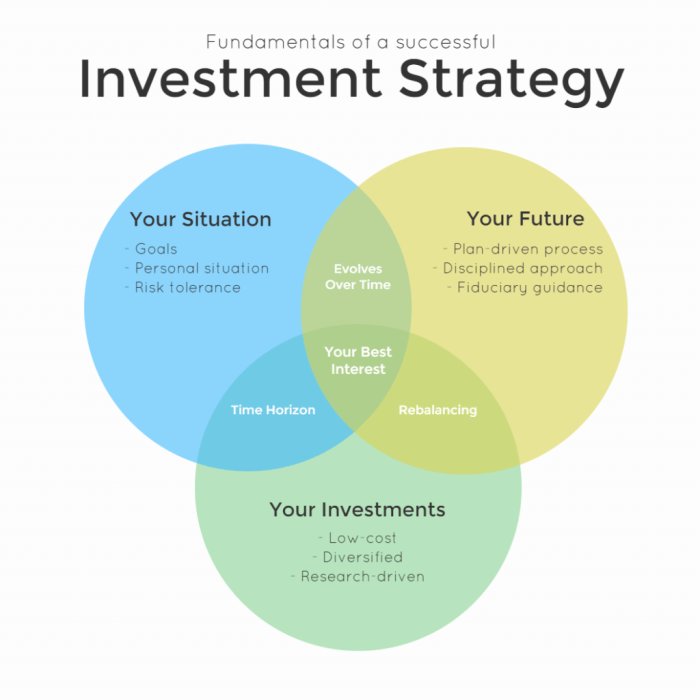
Asset allocation is a cornerstone of successful wealth management, representing the strategic distribution of investments across various asset classes to optimize risk and return. A well-defined asset allocation strategy considers an investor’s risk tolerance, financial goals, and time horizon, aiming to balance potential gains with the acceptable level of risk. This process involves careful consideration of several key factors.
Key Factors Influencing Asset Allocation Decisions
Several crucial factors influence how assets are allocated within an investment portfolio. Risk tolerance, a primary consideration, reflects an investor’s comfort level with potential losses. Time horizon, representing the duration of the investment strategy, significantly impacts asset allocation; longer time horizons generally allow for greater exposure to riskier, potentially higher-return assets. Financial goals, such as retirement planning or funding education, dictate the desired level of return and the acceptable risk level.
Market conditions, including interest rates and economic growth forecasts, also influence asset allocation choices. Finally, individual circumstances, such as age, income, and existing assets, play a significant role in determining a suitable asset allocation strategy.
Examples of Diverse Asset Allocation Models
Different asset allocation models cater to varying risk profiles and investment objectives. The classic 60/40 portfolio, a widely used approach, allocates 60% of the portfolio to equities (stocks) and 40% to bonds. This model offers a balance between growth potential and relative stability. Global diversification, another popular strategy, spreads investments across different countries and markets to reduce exposure to localized economic downturns.
A more aggressive approach might involve a higher allocation to equities and alternative investments, while a conservative approach might favor a greater proportion of bonds and cash. Specific allocations depend on individual circumstances and risk tolerance. For example, a younger investor with a longer time horizon might adopt a more aggressive 80/20 equity/bond split, while an investor nearing retirement might prefer a more conservative 40/60 split.
Comparison of Different Asset Classes
Different asset classes offer unique risk-return profiles. Equities, representing ownership in companies, offer the potential for high returns but also carry significant risk. Bonds, representing loans to governments or corporations, generally offer lower returns but are considered less risky than equities. Real estate, encompassing land and buildings, can provide both income and capital appreciation but involves illiquidity and management responsibilities.
Alternative investments, such as private equity, hedge funds, and commodities, offer diversification benefits but may be less transparent and less liquid.
Asset Class Characteristics and Potential Returns
Understanding the characteristics of different asset classes is crucial for effective asset allocation.
- Equities (Stocks): High growth potential, high volatility, relatively liquid. Potential returns vary greatly depending on market conditions and company performance. Examples include individual company stocks and exchange-traded funds (ETFs) tracking stock market indices.
- Bonds (Fixed Income): Lower growth potential than equities, lower volatility, generally liquid. Returns are influenced by interest rates and credit quality. Examples include government bonds, corporate bonds, and bond ETFs.
- Real Estate: Potential for income generation (rent) and capital appreciation, illiquid, requires management. Returns depend on property location, market conditions, and property management expertise. Examples include residential properties, commercial real estate, and REITs (Real Estate Investment Trusts).
- Alternative Investments: Potential for high returns and diversification, often illiquid and less transparent, higher risk. Returns vary significantly depending on the specific investment. Examples include hedge funds, private equity, commodities, and infrastructure.
Active vs. Passive Investing
Active and passive investing represent fundamentally different approaches to wealth management, each with its own philosophy, performance characteristics, and cost structure. Understanding these differences is crucial for investors to align their investment strategy with their risk tolerance, time horizon, and financial goals.Active investing involves a manager actively seeking to outperform a benchmark index by selecting specific securities believed to be undervalued or poised for superior returns.
Passive investing, conversely, aims to mirror the performance of a specific market index, such as the S&P 500, without attempting to pick individual winners and losers.
Philosophical Differences Between Active and Passive Investing
Active management rests on the belief that market inefficiencies exist, allowing skilled managers to identify and capitalize on mispriced assets. This requires extensive research, analysis, and trading activity. Passive management, in contrast, assumes market efficiency—that asset prices accurately reflect all available information, making consistent outperformance difficult and costly. Therefore, passive strategies focus on broad diversification to match market returns at a lower cost.
Performance Characteristics of Active and Passive Investment Strategies
Historically, the majority of actively managed funds have failed to consistently outperform their benchmark indices over the long term, net of fees. While some active managers achieve periods of outperformance, these are often not sustained. Passive strategies, by design, track the market’s performance, offering consistent returns that mirror the chosen index’s growth. However, it’s important to note that past performance is not indicative of future results, and market conditions can significantly impact both active and passive strategies.
For example, during periods of high market volatility, active managers may attempt to capitalize on short-term fluctuations, while passive strategies simply reflect the market’s overall movement.
Costs and Benefits of Active and Passive Investing
Active investing typically involves higher fees due to the extensive research, trading, and management involved. These fees can significantly impact overall returns. However, the potential benefit is the possibility of outperforming the market, generating higher returns than a passive approach. Passive investing, on the other hand, boasts lower fees, making it a more cost-effective option. The primary benefit is consistent, market-matching returns with minimal management overhead.
The trade-off is the lack of potential for significant outperformance.
Comparison of Active and Passive Management Fees
The following table illustrates a general comparison of management fees. Actual fees can vary widely depending on the specific fund, manager, and asset class.
| Investment Strategy | Typical Annual Fee Range | Fee Structure | Example |
|---|---|---|---|
| Actively Managed Mutual Fund | 0.75% – 2.00% | Management fee + expense ratio | A large-cap growth fund aiming to beat the S&P 500 |
| Actively Managed Hedge Fund | 1.00%
|
Management fee + performance fee | A fund employing complex trading strategies |
| Passive Index Fund (ETF) | 0.05% – 0.15% | Management fee | An S&P 500 index tracking exchange-traded fund |
| Passive Index Fund (Mutual Fund) | 0.10% – 0.50% | Management fee + expense ratio | A mutual fund mirroring a broad market index |
Specific Investment Vehicles
Understanding the various investment vehicles available is crucial for effective wealth management. Different vehicles offer unique risk-return profiles and suit varying investor goals and risk tolerances. Careful consideration of these characteristics is essential before committing capital.
Mutual Funds
Mutual funds pool money from multiple investors to invest in a diversified portfolio of securities, such as stocks, bonds, or other assets. This diversification helps mitigate risk. However, mutual funds are subject to market fluctuations and management fees can impact overall returns. The fund’s performance is directly tied to the underlying assets it holds, and investor returns are influenced by both the fund’s success and the expense ratio.
High expense ratios can significantly eat into profits over time. Investors should carefully review a fund’s prospectus before investing to understand its investment strategy, fees, and risks. For example, a growth-oriented mutual fund may invest primarily in stocks of companies expected to experience significant growth, while a bond fund would focus on fixed-income securities, offering potentially lower returns but greater stability.
Exchange-Traded Funds (ETFs)
ETFs are similar to mutual funds but trade on stock exchanges like individual stocks. This allows for intraday trading and greater flexibility. The investment process typically involves opening a brokerage account, researching ETFs based on investment goals and risk tolerance, placing an order to buy shares, and monitoring performance. ETFs often track a specific index, offering broad market exposure with lower expense ratios than many actively managed mutual funds.
For instance, an investor aiming for broad U.S. stock market exposure might choose an ETF tracking the S&P 500 index. The ease of trading and relatively low costs make ETFs attractive to many investors.
Hedge Funds and Private Equity
Hedge funds and private equity funds are typically available to accredited investors due to their higher minimum investment requirements and complex investment strategies. Hedge funds employ diverse strategies, often involving leverage and derivatives, aiming for high returns but also carrying substantial risk. Private equity focuses on investing in illiquid assets such as private companies or real estate, requiring long-term commitments and less liquidity.
Both asset classes often have lock-up periods, meaning investors can’t easily access their funds for a set period. The potential for high returns is offset by limited liquidity and the potential for significant losses. A successful hedge fund might generate alpha through sophisticated market timing or arbitrage strategies, while a private equity firm might achieve substantial returns by acquiring and restructuring underperforming companies.
Types of Bonds
Understanding the diverse characteristics of bonds is essential for effective portfolio diversification. The following list Artikels some common bond types:
- Treasury Bonds: Issued by the government, considered low-risk due to the backing of the government.
- Corporate Bonds: Issued by corporations to raise capital; riskier than government bonds, with yields reflecting the creditworthiness of the issuer.
- Municipal Bonds: Issued by state and local governments; often tax-exempt, making them attractive to investors in higher tax brackets.
- High-Yield Bonds (Junk Bonds): Offer higher yields but carry significantly higher risk of default.
- Inflation-Protected Securities (TIPS): Designed to protect investors from inflation; principal adjusts with inflation rates.
Successfully managing wealth involves a multifaceted strategy encompassing careful planning, risk assessment, and a deep understanding of various investment vehicles. By thoughtfully considering the information presented – from asset allocation models and risk management techniques to the tax implications of different investments and the growing importance of ESG factors – individuals can build a personalized approach to wealth creation and preservation that aligns with their long-term financial objectives.
Ultimately, informed decision-making, coupled with ongoing monitoring and adaptation, is key to achieving lasting financial success.
Expert Answers
What is the difference between a financial advisor and a wealth manager?
Financial advisors typically focus on broader financial planning, including budgeting and debt management. Wealth managers specialize in managing and growing significant assets, often employing more sophisticated investment strategies.
How often should I rebalance my investment portfolio?
Rebalancing frequency depends on your investment strategy and risk tolerance. A common approach is annual rebalancing, but some investors rebalance quarterly or even semi-annually.
What are the potential tax advantages of investing in retirement accounts?
Retirement accounts like 401(k)s and IRAs often offer tax-deferred growth or tax-deductible contributions, reducing your current tax burden and potentially increasing your long-term returns.
Is it better to invest in individual stocks or mutual funds?
The best choice depends on your investment knowledge, risk tolerance, and time commitment. Mutual funds offer diversification, while individual stocks can offer higher potential returns but with greater risk.


