
Navigating the complexities of wealth accumulation and preservation requires a strategic approach. A well-structured wealth management portfolio acts as the cornerstone of long-term financial success, offering a personalized roadmap to achieving financial goals. This guide delves into the essential elements of building and managing such a portfolio, from understanding diverse asset classes and investment strategies to mitigating risks and optimizing tax implications.
We will explore various portfolio types tailored to different risk tolerances, examining the nuances of asset allocation, diversification, and performance measurement. Beyond the purely investment-focused aspects, we’ll also touch upon the broader context of wealth management, encompassing estate planning, philanthropy, and the crucial role of a skilled wealth manager in guiding clients toward their financial aspirations.
Defining Wealth Management Portfolios
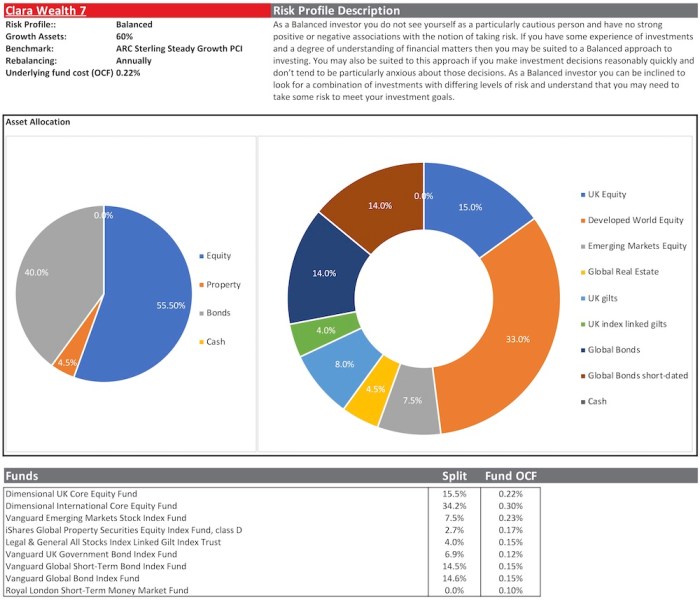
A wealth management portfolio is a diversified collection of assets designed to achieve a client’s long-term financial goals. It’s a personalized strategy tailored to individual risk tolerance, time horizon, and financial objectives. Understanding the core components and different portfolio types is crucial for effective wealth management.
The core components of a typical wealth management portfolio include a variety of asset classes, each with varying levels of risk and return potential. These typically include stocks (equities), bonds (fixed income), cash equivalents (money market accounts, etc.), and alternative investments (real estate, commodities, private equity, etc.). The specific mix of these assets is known as the portfolio’s asset allocation.
The proportion allocated to each asset class directly impacts the overall risk and return profile of the portfolio.
Portfolio Types and Asset Allocation Strategies
Different investors have different risk profiles and financial goals. Therefore, wealth management portfolios are often categorized into several types, reflecting varying levels of risk tolerance and investment objectives.
Conservative portfolios prioritize capital preservation and minimize risk. They typically allocate a larger portion of assets to low-risk investments like bonds and cash equivalents, with a smaller allocation to stocks. Moderate portfolios seek a balance between risk and return, aiming for steady growth while managing risk. They typically allocate assets across a wider range of asset classes, with a more even distribution between stocks and bonds.
Aggressive portfolios prioritize higher returns, accepting a greater level of risk. These portfolios typically have a higher allocation to stocks and other higher-risk investments, with a smaller allocation to bonds and cash.
| Asset Class | Allocation Percentage | Conservative Portfolio | Moderate Portfolio | Aggressive Portfolio |
|---|---|---|---|---|
| Stocks (Equities) | % | 20% | 40% | 70% |
| Bonds (Fixed Income) | % | 60% | 40% | 15% |
| Cash Equivalents | % | 20% | 10% | 5% |
| Alternative Investments | % | 0% | 10% | 10% |
Note: These are example allocations and may vary significantly based on individual circumstances and market conditions. A qualified financial advisor should be consulted to determine the appropriate asset allocation for your specific needs.
Investment Strategies within Wealth Management Portfolios
Crafting a successful wealth management portfolio requires a well-defined investment strategy tailored to individual financial goals, risk tolerance, and time horizon. This strategy dictates the asset allocation, investment vehicles, and overall approach to wealth growth and preservation. Understanding the various strategies and their implications is crucial for long-term financial success.
Long-term investment strategies are fundamental to building and preserving wealth. These strategies prioritize consistent growth over short-term gains, accepting some volatility in exchange for potentially higher returns over the long haul. The focus is on compounding returns and strategically adjusting the portfolio as circumstances change.
Examples of Long-Term Investment Strategies
Several long-term strategies can be employed, each with its own set of advantages and disadvantages. The selection depends on individual circumstances and preferences. For example, a buy-and-hold strategy involves purchasing assets and holding them for an extended period, regardless of short-term market fluctuations. Value investing focuses on identifying undervalued assets with the potential for significant appreciation. Growth investing prioritizes companies expected to experience rapid expansion, often characterized by higher risk and potential reward.
A global diversification strategy spreads investments across various countries and asset classes to mitigate risk associated with a single market or region. Finally, dollar-cost averaging involves investing a fixed amount of money at regular intervals, regardless of market price, reducing the impact of market volatility.
The Role of Diversification in Mitigating Risk
Diversification is a cornerstone of effective risk management in wealth management portfolios. It involves spreading investments across different asset classes, sectors, and geographies to reduce the impact of any single investment’s underperformance. By diversifying, investors aim to reduce the overall volatility of their portfolio and improve the chances of achieving their long-term financial goals. A well-diversified portfolio is less susceptible to significant losses from unexpected events or market downturns.
Comparison of Investment Vehicles
Various investment vehicles offer distinct risk-return profiles, liquidity characteristics, and tax implications. Understanding these differences is critical for constructing a balanced portfolio aligned with individual goals and risk tolerance. A balanced portfolio typically includes a mix of assets to optimize risk and return.
- Stocks (Equities): Represent ownership in a company. Offer high growth potential but also carry higher risk due to market volatility. Examples include individual company stocks and exchange-traded funds (ETFs) that track stock market indices.
- Bonds (Fixed Income): Represent loans made to corporations or governments. Generally considered less risky than stocks, offering relatively stable income streams but with lower growth potential. Examples include government bonds, corporate bonds, and bond funds.
- Real Estate: Involves investing in physical property. Can provide diversification, potential for rental income, and long-term appreciation, but also involves illiquidity and significant upfront capital requirements. Examples include residential properties, commercial real estate, and REITs (Real Estate Investment Trusts).
- Alternative Investments: Encompass a wide range of assets beyond traditional stocks and bonds, such as private equity, hedge funds, commodities, and precious metals. These investments often offer diversification benefits but may involve higher risk and lower liquidity.
Risk Management in Wealth Management Portfolios
Protecting and growing wealth requires a proactive approach to risk. Effective risk management is integral to the success of any wealth management portfolio, ensuring that investments align with an investor’s risk tolerance and financial goals. Ignoring risk can lead to significant losses and derail long-term financial plans.
Key Risk Factors Impacting Wealth Management Portfolios
Several factors can significantly impact the performance and stability of a wealth management portfolio. Understanding these risks is the first step towards effective mitigation.
- Market Risk: This encompasses fluctuations in market values due to economic conditions, geopolitical events, and investor sentiment. A downturn in the stock market, for example, can negatively impact equity holdings.
- Interest Rate Risk: Changes in interest rates affect the value of fixed-income securities like bonds. Rising interest rates generally lead to lower bond prices, while falling rates can increase their value.
- Inflation Risk: The erosion of purchasing power due to inflation can diminish the real return of investments. High inflation can outpace investment growth, reducing the overall value of assets.
- Currency Risk: Fluctuations in exchange rates can impact the value of international investments. A weakening domestic currency can reduce the value of foreign assets when converted back to the home currency.
- Credit Risk: This refers to the risk of default by borrowers, particularly relevant for investments in bonds or loans. A borrower’s inability to repay debt can result in financial losses.
- Liquidity Risk: This is the risk of not being able to sell an asset quickly without significantly impacting its price. Illiquid assets can be difficult to convert to cash when needed.
- Operational Risk: This includes risks associated with internal processes, systems, and human error within the wealth management firm itself. Examples include fraud, mismanagement, or technological failures.
Strategies for Managing and Mitigating Risks
A multi-faceted approach is crucial for effective risk management. This involves a combination of strategies tailored to the specific risks identified and the investor’s risk profile.
- Diversification: Spreading investments across different asset classes (stocks, bonds, real estate, etc.) and geographical regions reduces the impact of losses in any single area. This is a fundamental principle of risk mitigation.
- Asset Allocation: Carefully determining the proportion of assets allocated to different asset classes based on risk tolerance and investment goals. A conservative investor might allocate a larger portion to bonds, while a more aggressive investor might favor stocks.
- Hedging: Employing financial instruments like derivatives (options, futures) to offset potential losses from specific risks, such as currency fluctuations or interest rate changes. This involves strategically taking a position that would profit if the hedged risk materializes.
- Regular Monitoring and Rebalancing: Periodically reviewing the portfolio’s performance and adjusting the asset allocation to maintain the desired risk level and stay aligned with investment goals. This ensures the portfolio remains balanced over time.
- Due Diligence: Thoroughly researching and evaluating investments before committing funds. This involves understanding the risks associated with each investment and assessing its potential for growth.
Hypothetical Scenario Demonstrating How Risk Tolerance Affects Portfolio Construction
Consider two investors, Sarah and David. Sarah is a conservative investor with a low risk tolerance, while David is more aggressive with a high risk tolerance.Sarah’s portfolio might consist primarily of government bonds and high-quality corporate bonds, with a small allocation to blue-chip stocks. This portfolio aims for stability and capital preservation, prioritizing low risk over high potential returns.
A potential return might be 3-5% annually, but with minimal risk of significant losses.David’s portfolio, on the other hand, could include a significant allocation to equities, including growth stocks and emerging market investments, with a smaller allocation to bonds. This portfolio prioritizes higher potential returns but accepts a higher level of risk. A potential return might be 8-12% annually, but with a higher chance of experiencing significant fluctuations.
The potential for higher rewards comes with a commensurate increase in risk.
Wealth Management Portfolio Performance Measurement
Accurately measuring the performance of a wealth management portfolio is crucial for evaluating investment strategies, making informed decisions, and demonstrating value to clients. Several methods exist, each with its strengths and weaknesses, depending on the specific investment objectives and the portfolio’s complexity. Understanding these methods allows for a comprehensive assessment of portfolio success.
Performance measurement involves comparing the portfolio’s returns against a benchmark or a set of expectations. This comparison provides insights into the manager’s skill and the effectiveness of the chosen investment strategy. It also helps identify areas for improvement and potential risks.
Methods for Measuring Portfolio Performance
Several methods exist for gauging the success of a wealth management portfolio. These methods vary in complexity and the data required. A holistic approach often involves using a combination of these techniques to get a complete picture.
Common methods include:
- Time-Weighted Return (TWR): This method adjusts for the impact of cash inflows and outflows, providing a more accurate representation of the investment manager’s skill. It isolates the investment performance from the timing of deposits and withdrawals.
- Money-Weighted Return (MWR): This method considers the timing and amount of cash flows, reflecting the overall return to the investor. It’s useful when evaluating the impact of investor decisions on the portfolio’s performance.
- Benchmark Comparison: This involves comparing the portfolio’s performance against a relevant benchmark, such as a market index (e.g., S&P 500) or a peer group of similar portfolios. This provides context and helps assess relative performance.
- Sharpe Ratio: This measures risk-adjusted return by considering the excess return relative to the risk-free rate and the portfolio’s standard deviation. A higher Sharpe ratio indicates better risk-adjusted performance.
- Sortino Ratio: Similar to the Sharpe ratio, but it only considers downside deviation, focusing on the risk of losses. This is a more refined measure for risk-averse investors.
Key Performance Indicators (KPIs) in Portfolio Evaluation
Numerous KPIs are used to evaluate a wealth management portfolio’s performance. These metrics provide a quantitative assessment of various aspects of the portfolio’s success. Selecting the appropriate KPIs depends on the investor’s goals and risk tolerance.
Examples of key KPIs include:
- Total Return: The overall return achieved by the portfolio over a specified period, including capital appreciation and income.
- Annualized Return: The average annual return of the portfolio over a specified period, adjusted for compounding.
- Standard Deviation: A measure of the portfolio’s volatility, indicating the dispersion of returns around the average.
- Beta: A measure of the portfolio’s systematic risk, reflecting its sensitivity to market movements.
- Alpha: A measure of the portfolio’s excess return relative to its benchmark, indicating the manager’s skill in generating returns above the market.
- Maximum Drawdown: The largest peak-to-trough decline in the portfolio’s value over a specified period, indicating the portfolio’s downside risk.
Risk and Return Relationship in Portfolio Performance
The relationship between risk and return is fundamental in portfolio performance. Generally, higher potential returns are associated with higher levels of risk. This relationship is often visualized using a graph.
Visual Representation:
Imagine a two-dimensional graph. The x-axis represents risk (typically measured by standard deviation), and the y-axis represents return (typically measured as annualized return). A scatter plot would show individual data points representing different portfolios. The points would generally cluster along an upward-sloping line, illustrating that higher risk tends to be associated with higher returns. However, the relationship is not perfectly linear; some high-risk portfolios may underperform, while some low-risk portfolios may surprisingly outperform.
The efficient frontier, a curve that envelopes the highest return for each level of risk, would be a key element of this visualization. Portfolios lying on this curve represent optimal risk-return combinations. Portfolios below the curve are suboptimal, offering less return for the same level of risk or more risk for the same level of return. Portfolios above the curve are theoretically possible but practically unattainable in real-world scenarios.
Tax Implications of Wealth Management Portfolios
Understanding the tax implications of various assets within a wealth management portfolio is crucial for maximizing long-term returns. Tax efficiency isn’t just about minimizing your tax bill; it’s about strategically structuring your investments to optimize growth and preserve capital. Ignoring tax implications can significantly reduce your overall wealth accumulation.Tax laws significantly impact investment decisions, influencing portfolio construction and asset allocation strategies.
Different asset classes are subject to different tax treatments, requiring a tailored approach to wealth management.
Tax Implications of Different Asset Classes
The tax implications vary considerably depending on the asset class held within a portfolio. For example, capital gains taxes apply differently to stocks, bonds, and real estate, impacting the overall return.
- Stocks: Capital gains taxes apply to profits from the sale of stocks. The tax rate depends on the holding period (short-term or long-term) and the investor’s income bracket. Dividends received from stocks are also taxable, often at preferential rates compared to ordinary income.
- Bonds: Interest income from bonds is generally taxed as ordinary income. This means it’s taxed at the investor’s marginal tax rate, which can be significantly higher than the capital gains rate for long-term investments.
- Real Estate: Real estate investments involve various tax considerations, including capital gains taxes on the sale of property, depreciation deductions, and property taxes. The complexities of real estate taxation often necessitate specialized professional advice.
- Mutual Funds and ETFs: These investments distribute capital gains and dividends to shareholders, which are then taxable events. The tax implications depend on the fund’s investment strategy and the investor’s individual tax circumstances. Tax-efficient funds aim to minimize these distributions.
Tax Optimization Strategies
Several strategies can help optimize the tax efficiency of a wealth management portfolio. These strategies aim to minimize the overall tax burden without compromising investment goals.
- Tax-Loss Harvesting: This strategy involves selling losing investments to offset capital gains, reducing the overall tax liability. It requires careful planning and consideration of wash-sale rules.
- Tax-Advantaged Accounts: Utilizing retirement accounts like 401(k)s and IRAs allows for tax-deferred growth. Contributions may be tax-deductible, and withdrawals are often taxed only in retirement.
- Tax-Efficient Funds: Investing in funds designed to minimize capital gains distributions can reduce the tax burden compared to more actively traded funds.
- Diversification Across Tax Brackets: Strategically allocating assets across different tax-advantaged accounts can help to manage overall tax exposure.
Impact of Tax Laws on Investment Decisions
Tax laws directly influence investment choices. For instance, the preferential tax treatment of long-term capital gains often encourages investors to hold assets for longer periods, potentially influencing asset allocation decisions.
Tax laws are dynamic and subject to change. Therefore, regular review and adjustment of investment strategies are essential to maintain tax efficiency.
Changes in tax rates or legislation can significantly alter the attractiveness of certain investments. For example, an increase in capital gains taxes might lead investors to favor dividend-paying stocks over growth stocks, or shift towards tax-exempt bonds. A thorough understanding of current and potential future tax implications is therefore paramount for effective wealth management.
Wealth Management Beyond Investments
Wealth management encompasses far more than simply building and maintaining an investment portfolio. A truly holistic approach considers the interconnectedness of your financial life, your personal goals, and your legacy. It’s about strategically planning for all aspects of your financial well-being, ensuring your resources are aligned with your values and aspirations, both present and future. This extends beyond the realm of stocks and bonds to include crucial elements like estate planning and philanthropic endeavors.Effective wealth management integrates various financial disciplines to achieve long-term financial security and peace of mind.
It’s about proactively addressing potential challenges and opportunities, ensuring your wealth works for you across all stages of your life. This proactive approach considers not only the growth of assets but also their preservation and efficient transfer to future generations.
Estate Planning Considerations
Estate planning involves the strategic management of your assets and their distribution after your death. This includes drafting a will or trust to specify how your assets will be passed on, minimizing potential estate taxes, and appointing guardians for minor children (if applicable). Effective estate planning ensures a smooth transition of assets and minimizes potential family disputes. For example, a carefully structured trust can provide for the ongoing care of a disabled family member while ensuring that other beneficiaries receive their inheritances according to your wishes.
Another example would be the use of life insurance to cover estate taxes, preventing the forced sale of assets to meet tax obligations. Careful consideration of probate avoidance strategies is also crucial.
Philanthropic Giving Strategies
Philanthropy allows you to contribute to causes you care about while potentially receiving tax benefits. Strategies include establishing a charitable foundation, making donations of appreciated assets, or utilizing donor-advised funds. For instance, donating appreciated stock instead of cash can reduce capital gains taxes while supporting a chosen charity. Creating a charitable remainder trust can provide you with income during your lifetime while ensuring a significant contribution to your chosen charity after your death.
Such strategies allow for tax-efficient giving and the creation of a lasting legacy.
Legacy Planning
Legacy planning goes beyond simply transferring assets; it’s about leaving a lasting impact on your family and the world. This includes defining your values and sharing them with your heirs, documenting family history, and establishing clear communication regarding your wishes. For example, creating a family history book or video can preserve memories and strengthen family bonds. Mentoring younger family members in financial management is another aspect of legacy planning, ensuring that future generations are equipped to manage their own wealth responsibly.
The preservation of family values and traditions through intentional actions forms an integral part of building a strong and lasting legacy.
Key Elements of Comprehensive Wealth Management
A comprehensive wealth management plan typically integrates the following key elements:
- Financial Planning: Developing a detailed plan to achieve your financial goals, including retirement planning, education funding, and debt management.
- Investment Management: Building and managing an investment portfolio aligned with your risk tolerance and financial objectives.
- Tax Planning: Minimizing your tax liability through strategic financial decisions.
- Estate Planning: Planning for the distribution of your assets after your death.
- Risk Management: Identifying and mitigating potential financial risks, such as insurance needs and liability protection.
- Philanthropic Planning: Developing a strategy for charitable giving.
- Legacy Planning: Defining your values and ensuring your legacy aligns with your intentions.
WEALTH MANAGEMENT (Broader Context)
Wealth management extends beyond simply investing; it encompasses a holistic approach to managing a client’s financial life, aligning their financial resources with their personal goals and values. A skilled wealth manager acts as a trusted advisor, navigating the complexities of financial planning to help clients achieve their aspirations, whether it’s securing their retirement, funding their children’s education, or establishing a lasting legacy.The relationship between a wealth manager and their client is built on trust and transparency.
Effective wealth management requires a deep understanding of the client’s unique circumstances, including their risk tolerance, investment timeline, and financial objectives. This understanding informs the creation of a personalized financial plan that addresses all aspects of their financial well-being.
The Role of a Wealth Manager in Guiding Clients Towards Financial Goals
Wealth managers play a multifaceted role in guiding clients towards their financial objectives. They begin by carefully assessing a client’s current financial situation, identifying assets, liabilities, and income streams. This detailed assessment serves as the foundation for developing a comprehensive financial plan. The plan Artikels specific strategies for achieving the client’s goals, encompassing investment management, tax planning, estate planning, and risk management.
Regular reviews and adjustments ensure the plan remains aligned with the client’s evolving needs and market conditions. For instance, a young professional saving for retirement might benefit from a more aggressive investment strategy with a higher risk tolerance than a retiree nearing the end of their working life. The wealth manager adapts the strategy to suit each life stage and evolving circumstances.
Ethical Considerations in Wealth Management Practices
Ethical conduct is paramount in wealth management. The fiduciary duty, a legal and ethical obligation to act in the best interests of the client, is central to the profession. This includes avoiding conflicts of interest, maintaining client confidentiality, and providing unbiased advice. Transparency in fees and investment strategies is crucial for building trust and ensuring clients understand the services they are receiving.
Ethical breaches, such as recommending unsuitable investments or misrepresenting financial information, can have severe consequences, both legally and reputationally. A robust code of ethics and adherence to regulatory guidelines are essential for maintaining the integrity of the wealth management profession. Examples of ethical dilemmas might include choosing between a higher-fee investment product that benefits the manager versus a lower-fee alternative that better suits the client’s needs, or disclosing a potential conflict of interest when making recommendations.
Comparison of Different Wealth Management Philosophies
Different wealth management philosophies exist, each with its own approach to investing and financial planning. A passive approach, for example, emphasizes low-cost index funds and a buy-and-hold strategy, minimizing trading activity and focusing on long-term growth. This contrasts with an active approach, which involves more frequent trading and attempts to outperform the market through skillful stock picking and market timing.
Another key difference lies in the level of customization. Some firms offer highly personalized portfolios tailored to individual client needs, while others use more standardized investment strategies. Finally, approaches may differ in their focus, with some prioritizing capital preservation above all else, while others emphasize aggressive growth, even at the cost of higher risk. The choice of philosophy should align with the client’s risk tolerance, investment timeline, and overall financial goals.
For instance, a conservative investor focused on preserving capital might prefer a passive, low-risk strategy, while a younger investor with a longer time horizon might tolerate more risk in pursuit of higher returns.
Ultimately, constructing and maintaining a successful wealth management portfolio is a dynamic process that requires careful planning, ongoing monitoring, and adaptation to changing market conditions. By understanding the core principles of asset allocation, risk management, and tax optimization, individuals can empower themselves to make informed decisions and build a robust financial foundation for the future. Remember, seeking professional advice is crucial, particularly when navigating complex financial landscapes.
Key Questions Answered
What is the difference between a financial advisor and a wealth manager?
Financial advisors typically focus on investment management and financial planning. Wealth managers offer a broader scope, encompassing financial planning, investment management, tax planning, estate planning, and other wealth-related services.
How often should I review my wealth management portfolio?
Ideally, your portfolio should be reviewed at least annually, or more frequently depending on significant life events or market volatility. Regular reviews ensure your investments align with your evolving goals and risk tolerance.
What are the fees associated with wealth management services?
Fees vary significantly depending on the services offered and the wealth manager’s structure. Common fee structures include percentage-based fees on assets under management, hourly rates, or a combination of both.
Can I manage my own wealth management portfolio?
While self-managing is possible, it requires significant financial literacy and time commitment. For complex financial situations or those lacking the necessary expertise, professional guidance is highly recommended.


